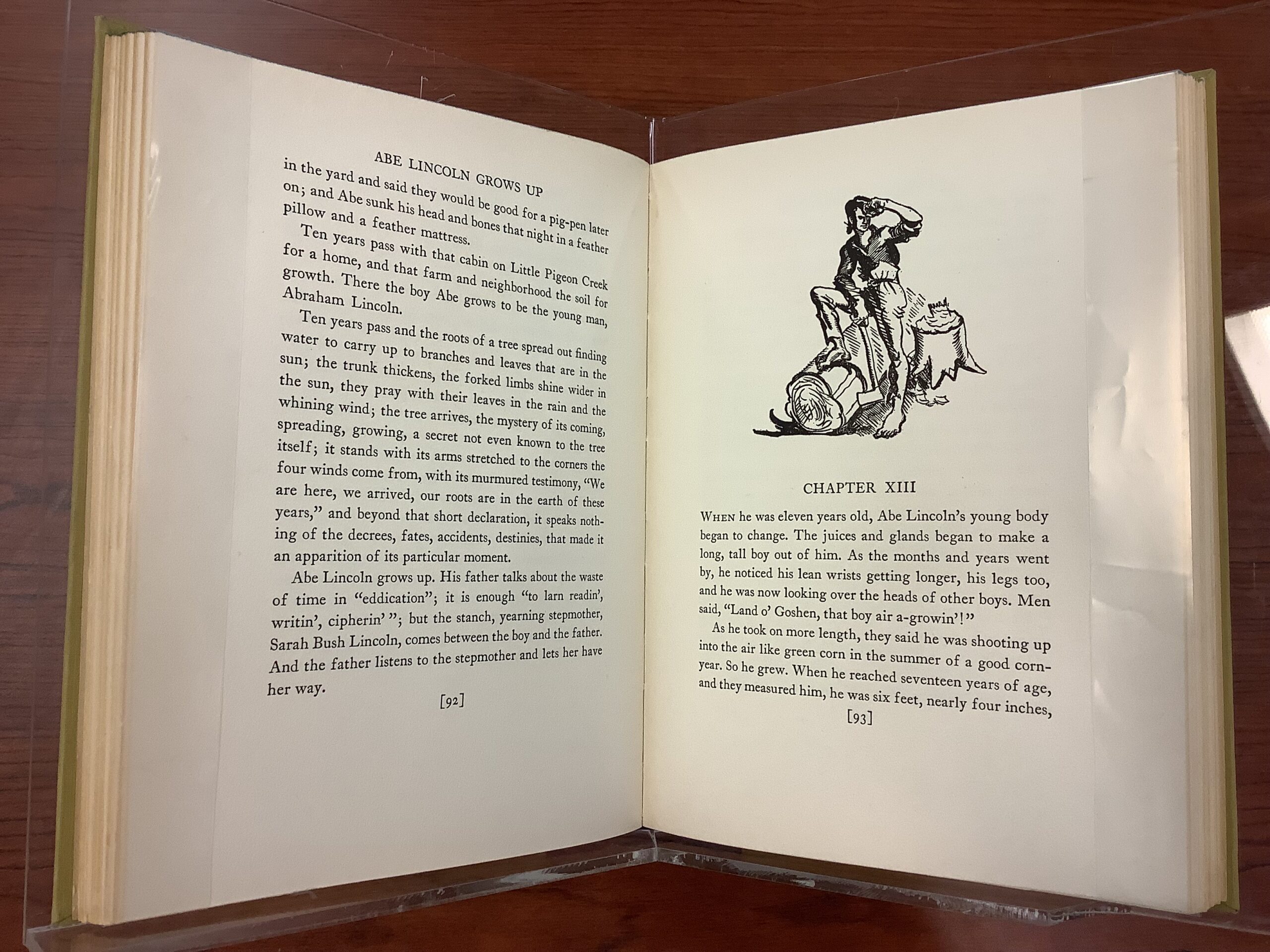

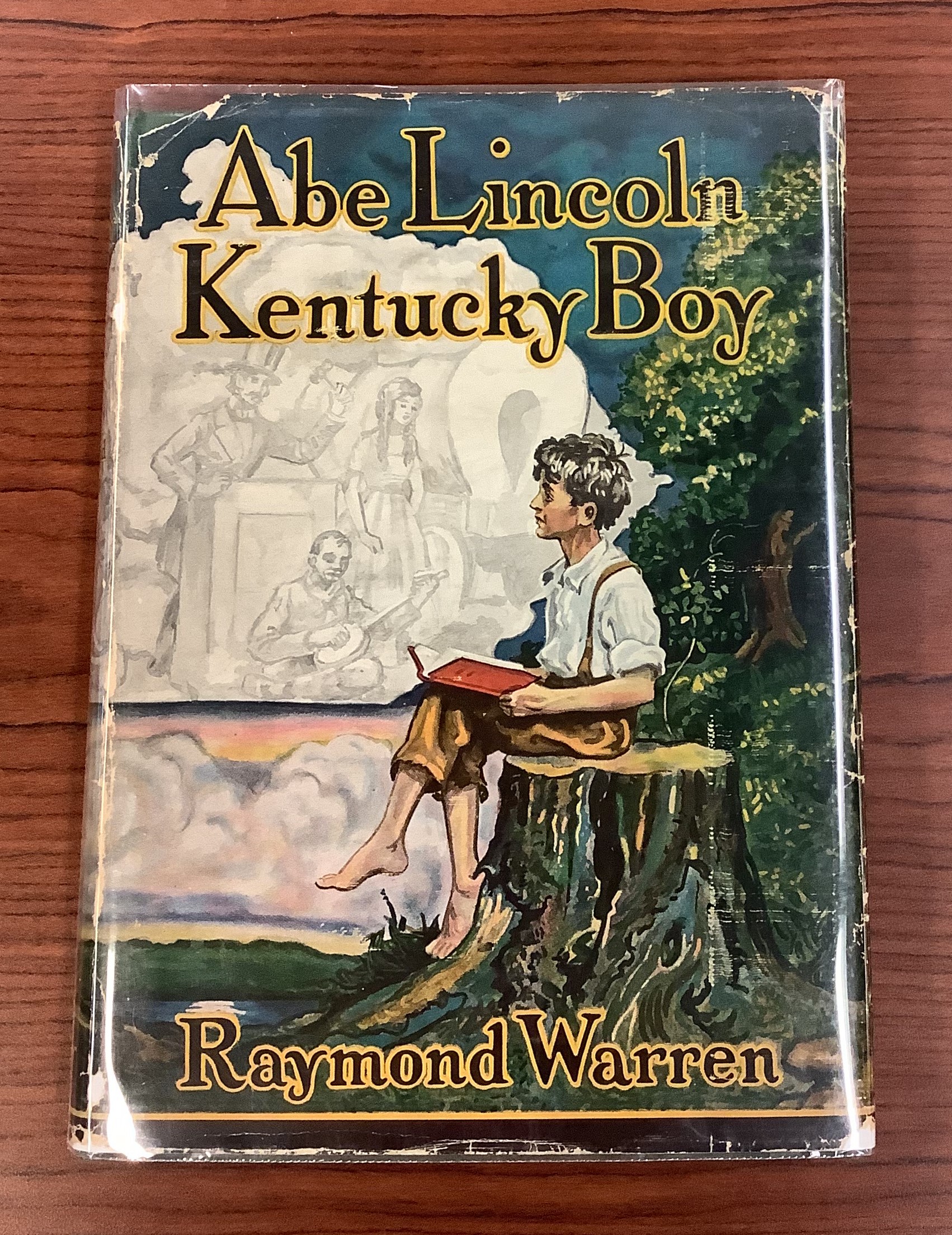
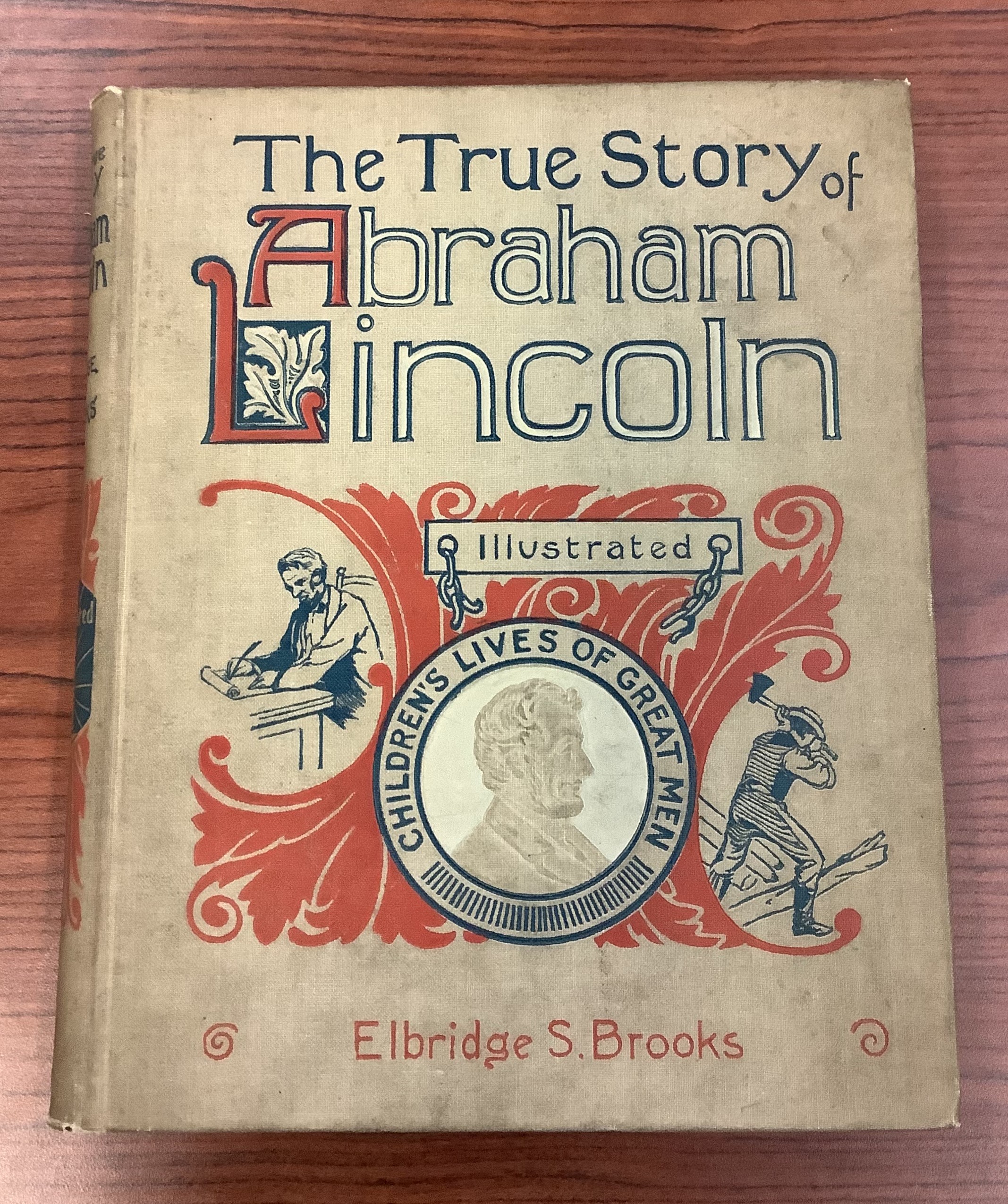
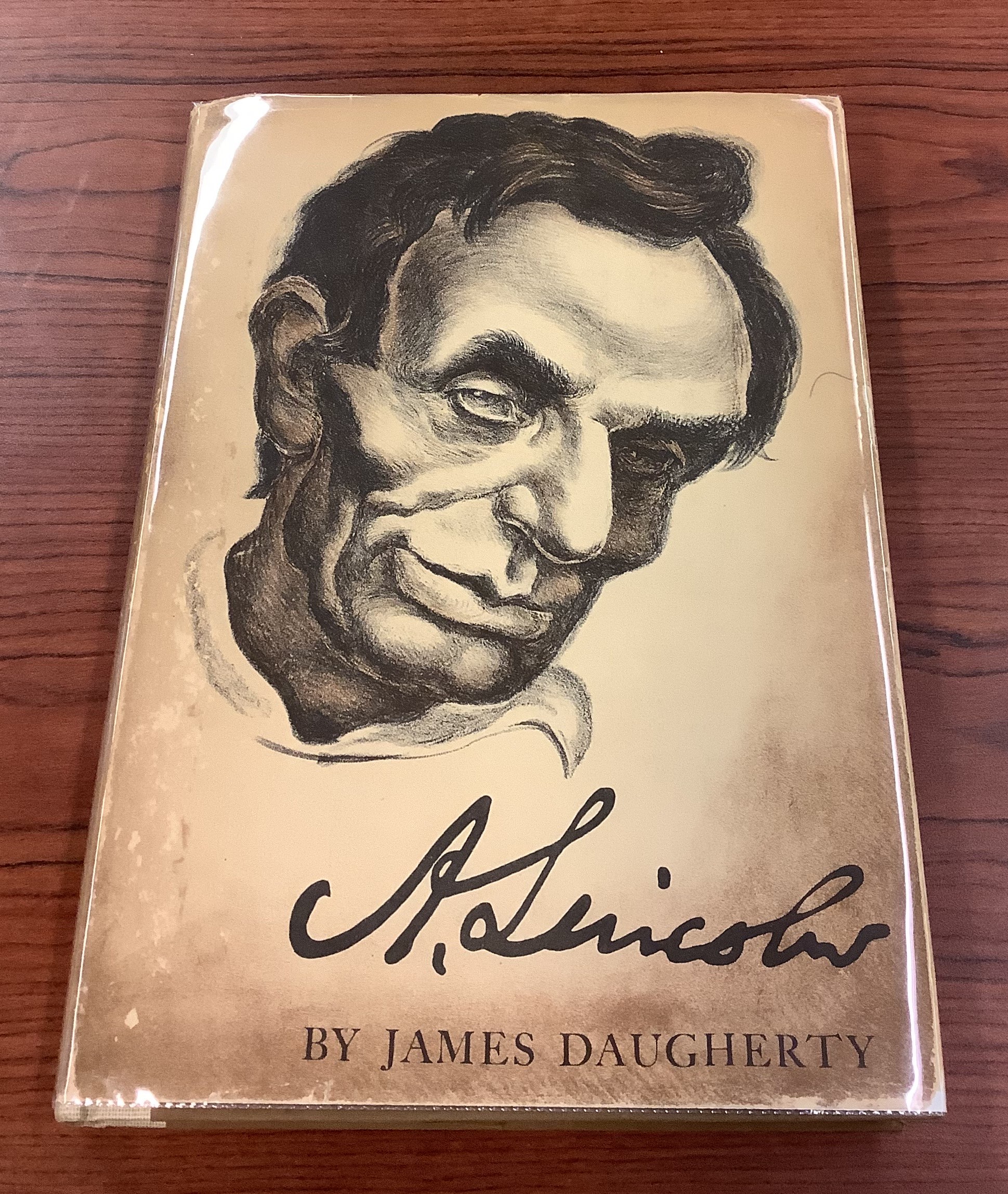
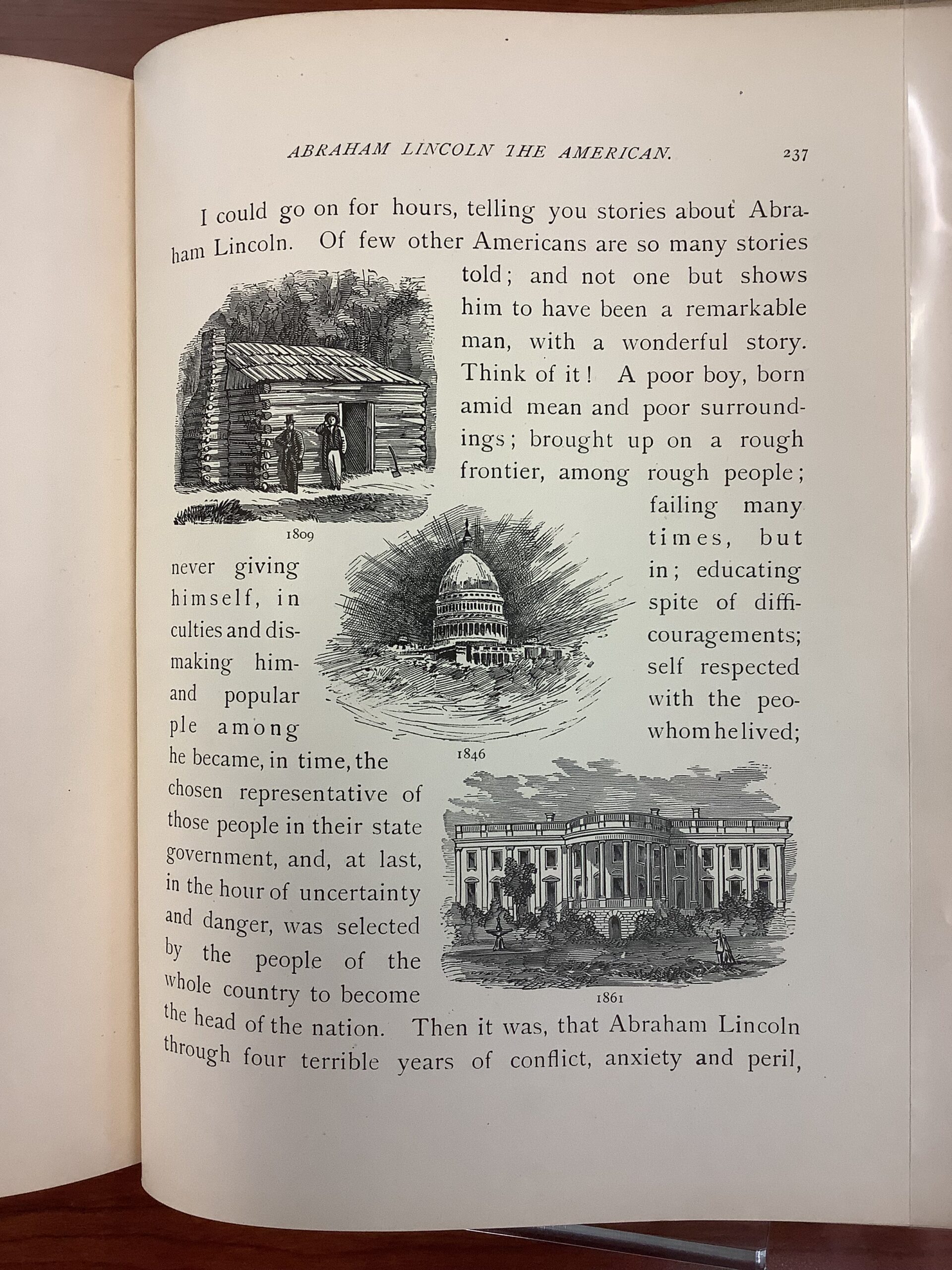
Expanding beyond personal values and morals, juvenile literature also frames Abraham Lincoln as the embodiment of a distinctly American story of pioneer spirit and social uplift. As the nation rapidly expanded west, the persona of the rugged, hardworking everyman forged on the frontier quickly defined what it meant to be American and, with his bare feet, strong muscles and log man’s axe, no one fit the mold better than Lincoln. James Daugherty’s Abraham Lincoln (item 16) tellingly opens with a tribute to the pioneer type Lincoln exemplified: “a slow plowman out of the heart of the continental plain” with no ties to traditional geographic centers or power structures. Moreover, his rise from a humble log cabin to the White House is commonly depicted as a rags to riches tale that symbolizes the infinite possibilities of the frontier. A series of illustrations in Elbridge S. Brooks’s The true story of Abraham Lincoln, the American: told for boys and girls (item 15) notably visualizes this ascent as Brooks concludes that “he [Lincoln] stands as a type - as, before all others, the American.”
Table of contents:
- Putnam, M. Louise. The children’s life of Abraham Lincoln. Chicago: A.C. McClurg, 1892.
- Warren, Raymond. Abe Lincoln, Kentucky boy. Chicago: The Reilly & Lee Co., 1931.
- Brooks, Elbridge S. (Elbridge Streeter). The true story of Abraham Lincoln, the American: told for boys and girls. Boston: Lothrop Publishing Company, 1896.
- Daughterty, James. Abraham Lincoln. New York: Junior Literary Guild: Viking Press, 1943.
- Sandberg, Carl, author; Daugherty, James, illustrator. Abe Lincoln grows up. New York: Harcourt, Brace and Co., 1928.
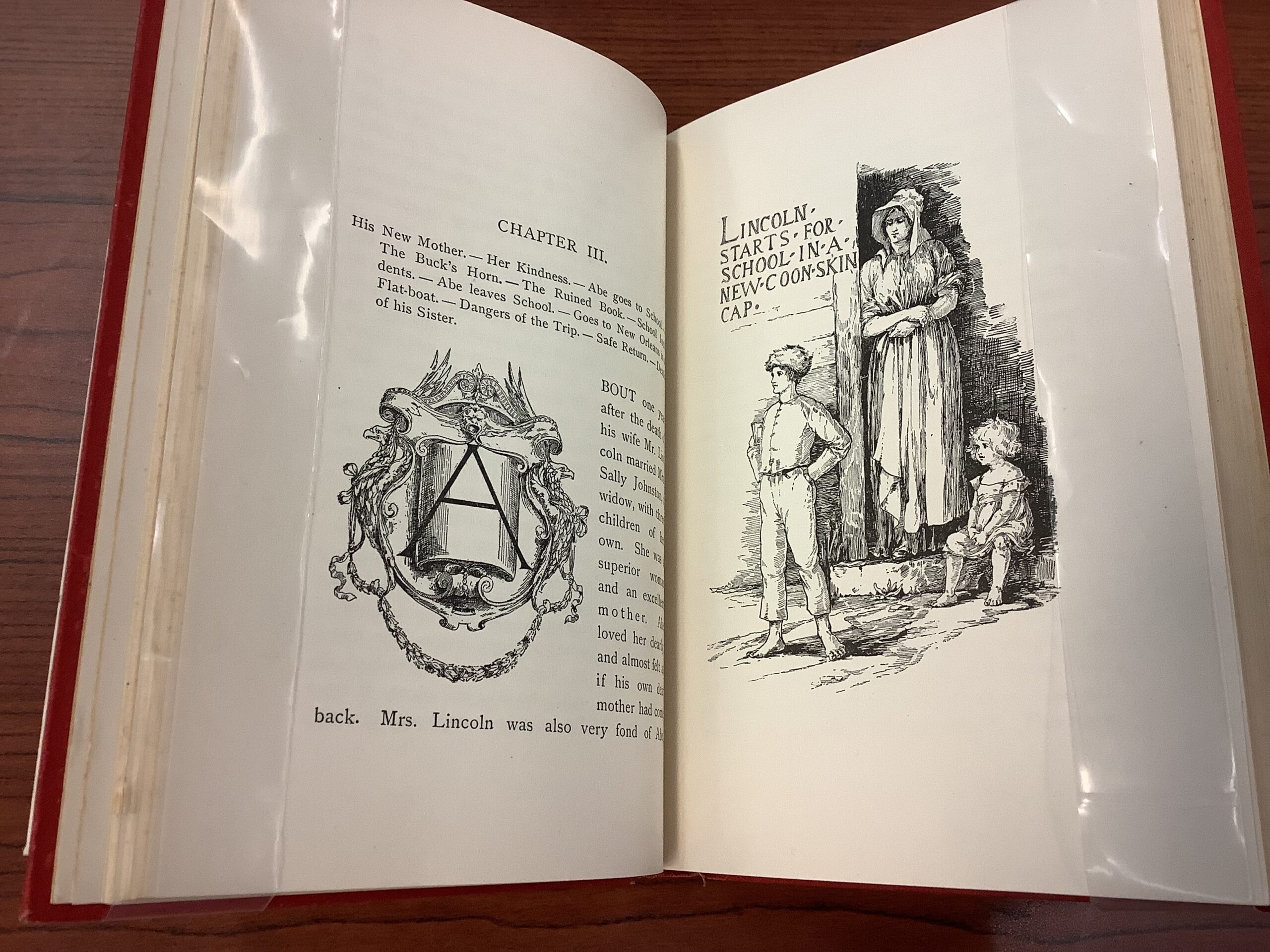
This illustration, introducing chapter 3 of The Children’s Life of Abraham Lincoln, depicts young Lincoln in his iconic coonskin cap, bare feet, and strong stature.
Elbridge Streeter Brooks breaks up his retelling of Lincoln's many life experiences with illustrations of the buildings most associated with his rise from humble frontiersman to president of the United States: his log cabin, the state capitol building of Illinois, and finally, the White House.
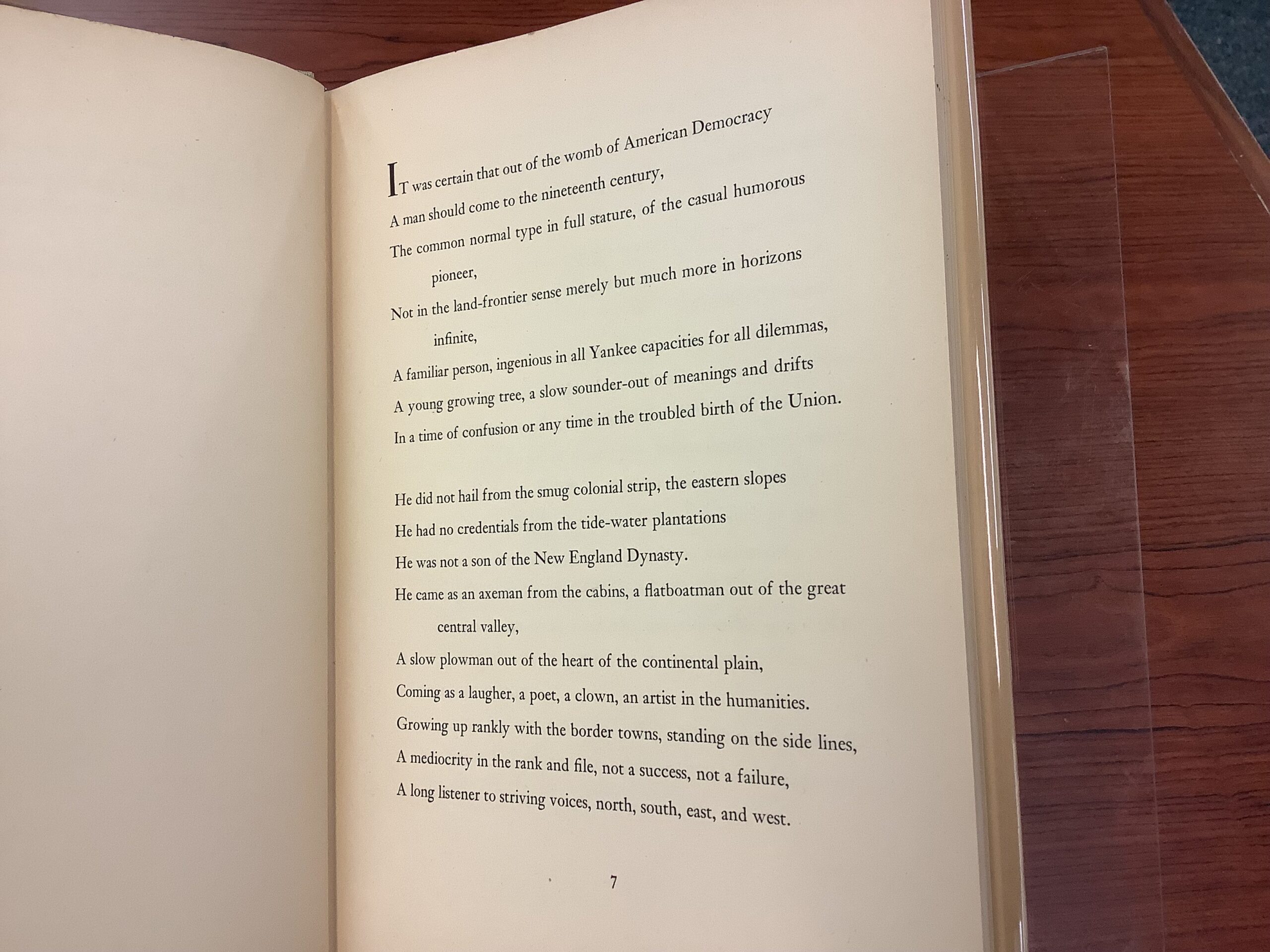
Daugherty's poem, which opens his 1943 work Abraham Lincoln, illustrates Lincoln's humanity, not just as the boy pioneer and heroic president, but a kind man as well:
"He came as an axeman from the cabins, a flatboatman of of the great central valley,
A slow plowman out of the heart of the continental plain,
Coming as a laugher, a poet, a clown, an artist in the humanities."